

Press release: Exhibition Pixel Pioneers in Rotterdam at the Depot of Museum Boijmans Van Beuningen
From retro‑computers to experimental digital installations
From 25 April 2026, Museum Boijmans Van Beuningen presents Pixel Pioneers, an exhibition dedicated to digital art. Technology, ranging from gaming and apps to phones and digital tools, is an integral part of our daily lives. It also increasingly plays a role in contemporary art. Pioneering international artists of digital art are given, for the first time a platform at the Depot. The presentation spans a wide range of works, from algorithmically generated paintings and audiovisual installations to interactive retro-games. Alongside newly commissioned and contemporary works, Pixel Pioneers also draws on the museum’s collection, including key examples from the 1960s that mark early developments in digital art. Moving between past and present, the exhibition considers how artists have used technology to bring to life the stories of their time.
The exhibition presents works by: Larry Achiampong, Claudia Hart, Suzanne Koopstra, Christopher Kulendran Thomas, Feng Mengbo, Geert Mul and Suzanne Treister.
The Art of Algorithms
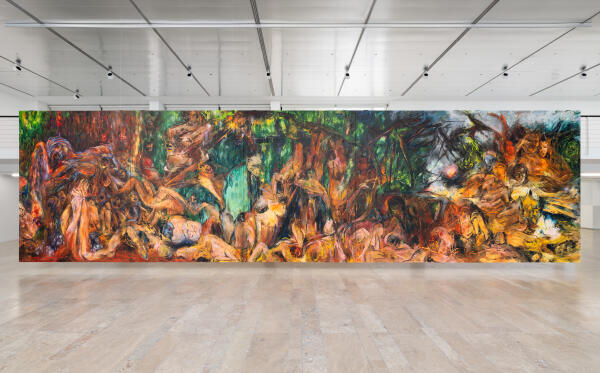
One major development in contemporary painting is the use of digital tools such as artificial intelligence in the creative process. Christopher Kulendran Thomas presents large-scale paintings based on digital images generated by computer programs. Exploring the complex history of Sri Lanka from the perspective of his Tamil heritage, the computer-generated images were trained to draw from the work of famous Sri Lankan artists who were influenced by the Western art historical canon. His work raises questions about authorship and shows how images determine what is remembered.
Digital Art Restored
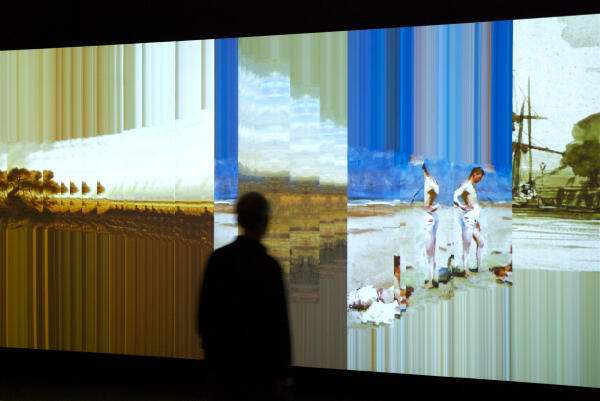
The exhibition features a key digital-born artwork from the museum’s collection: Horizons (2008/2026) by Dutch artist Geert Mul (b. 1965, Netherlands), whose practice explores how museum collections and digital databases intersect. Commissioned by the museum nearly two decades ago, Horizons brings together images from the collection featuring a horizon and projecting them onto a large screen. Through motion sensors, visitors generate new compositions with every movement, activating the work as a constantly shifting landscape. Recently restored for this exhibition, Horizons offers renewed insight into the challenges and possibilities of preserving digital art: How does one go about restoring a digital artwork and why is this needed? The documentary by Suzanne Koopstra follows this restoration process and reveals the challenges of technologically dependent artworks and their future within museum collections.
Games Full of Stories
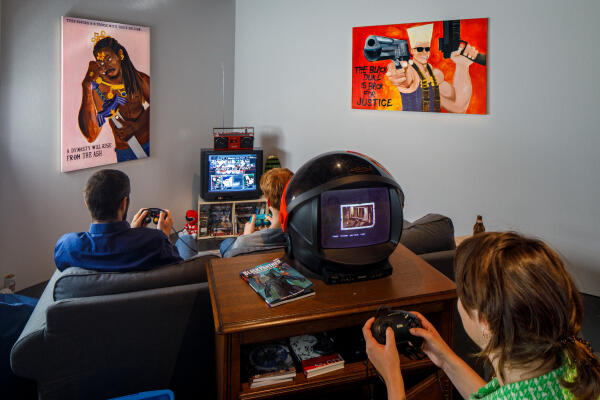
In The Gaming Room, Larry Achiampong (b. 1984, United Kingdom) approaches video games as a personal and cultural experience. His installation brings together early video games with consoles, books, music, film and nostalgic items to create an inviting living room setting. Achiampong used to experience games as instructive places. Repeatedly attempting challenging levels, discovering hidden worlds and making choices helped him shape his ideas about growing up and surviving. Visitors are invited in this gathering space, to get hold of the controls themselves and experience how gaming brings together people, memories and cultures.
Between Digital and Physical Worlds
Pixel Pioneers also highlights artists who use digital tools to question commonly held ideas. The museum commissioned Claudia Hart (b. 1955, United States) to create Empire Failure and The Rise & Fall of Art and Other Histories which puts on display the power of big tech companies and likens their rise and fall to historical empires. Hart uses the logos of tech companies and symbols of failed cryptocurrencies in the work. Suzanne Treister (b. 1958, United Kingdom) presents work from her HEXEN 2.0 (2009-2011) and HEXEN 5.0 (2023-2025) series: colourful tarot cards that reveal the hidden story of the internet, blockchain and artificial intelligence (AI). In a playful mix of fact and fiction, Treister exposes the secret worlds behind the technologies we use every day.
Statement in pixels
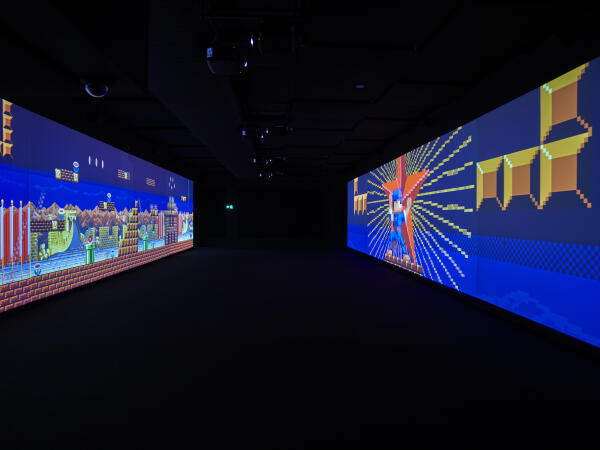
Monumental interactive installations by pioneers like Feng Mengbo (b. 1966, China) show how a video game can be used to make social and political statements. In his iconic Long March: Restart (2008), Feng brought to life an important period in Chinese history* in a playable retro video game. The game is presented in a 17-metre-long projection.
The Origins of Digital Art
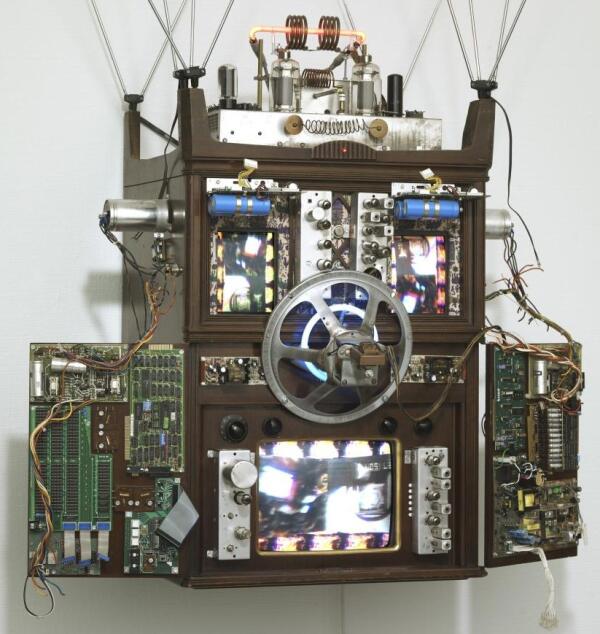
Since the late twentieth century, the museum has collected film, video and electronics-based works. Featuring works from the Museum Boijmans Van Beuningen collection by Hoos Blotkamp (1943-2014, Netherlands), Nam June Paik (1932-2006, South Korea), and Peter Struycken (b. 1939, Netherlands), this exhibition highlights these works as part of a broader landscape that has defined digital art – genre that continues to evolve since it first emerged in the 1960s – bringing these histories into dialogue with contemporary practices.

Benefactors
Pixel Pioneers is sponsored by the Mondrian Fund, the VriendenLoterij lottery, Stichting Museum Boijmans Van Beuningen – with a donation from the estate of Rine Coolen-Kalkman – and Rotterdam city council. The restauration of Horizons is made with the support of the De Heus Family Restoration Fund.
Pixel Pioneers is on view from 25 April through 13 September 2026.
Blockchain: A technology that enables a network of users to collectively maintain a shared database of transactions.
Artificial intelligence: The ability of a machine to demonstrate human‑like capabilities such as reasoning, learning, planning, and creativity.
Algorithms: A set of rules and instructions that a computer follows to perform a task.
Long March - Restart: The title refers to the Long March of 1934-1935, the gruelling military retreat by the Chinese army under the command of Mao Zedong, which later became a founding myth of Communist China and a powerful state propaganda tool. Feng compares the actions of revolutionaries with the antics of video game characters, thus satirically questioning the myths of history.